Search question this page answers: Which hydraulic component family is most likely failing on a JCB-class backhoe or excavator — and what should procurement quote next?
This is the system map. It is not a duplicate of hydraulic pump failure, cylinder leaking, or the ordered hydraulic troubleshooting sequence. Use those for one symptom or a workshop checklist. Use this page when you still need the map. These notes identify parts to quote. They are not a certified repair procedure.
Not sure which component is causing the problem?
Describe the symptom in one sentence, attach a photo of the leak or gauge area, and send machine model + serial. We help map the family before you order the wrong line.
Request symptom review on quote · Send a photo for identification
Symptom → possible system / component
Buyers search “hydraulic system failure”, “jcb breakdown”, or “jcb hydraulic systems” after slow cycle, heat, foaming, drift, or a bypass warning. One circuit has several wear points. Ordering a pump because the boom is slow is a common miss: a clogged return filter or a leaking cylinder can look the same from the seat.
| Symptom | Check first | Often quote next | Deep link |
|---|---|---|---|
| Whine / pressure drop / metal in oil | Oil level, suction strainer | Pump, filters | Pump failure |
| External weep at rod gland | Rod scoring, gland plate | Seal kit (bore/rod measured) | Cylinder leaking |
| Boom settles, gland looks dry | Holding valve vs cylinder bypass | Valve or seal kit after isolation | Boom drift |
| Slow cycle after cold start | Oil grade, return filter, bypass | Filters, oil, then pump | Filter clogging |
| Burst hose / foam | Contamination event | Hose + filters + tank clean | Troubleshooting |
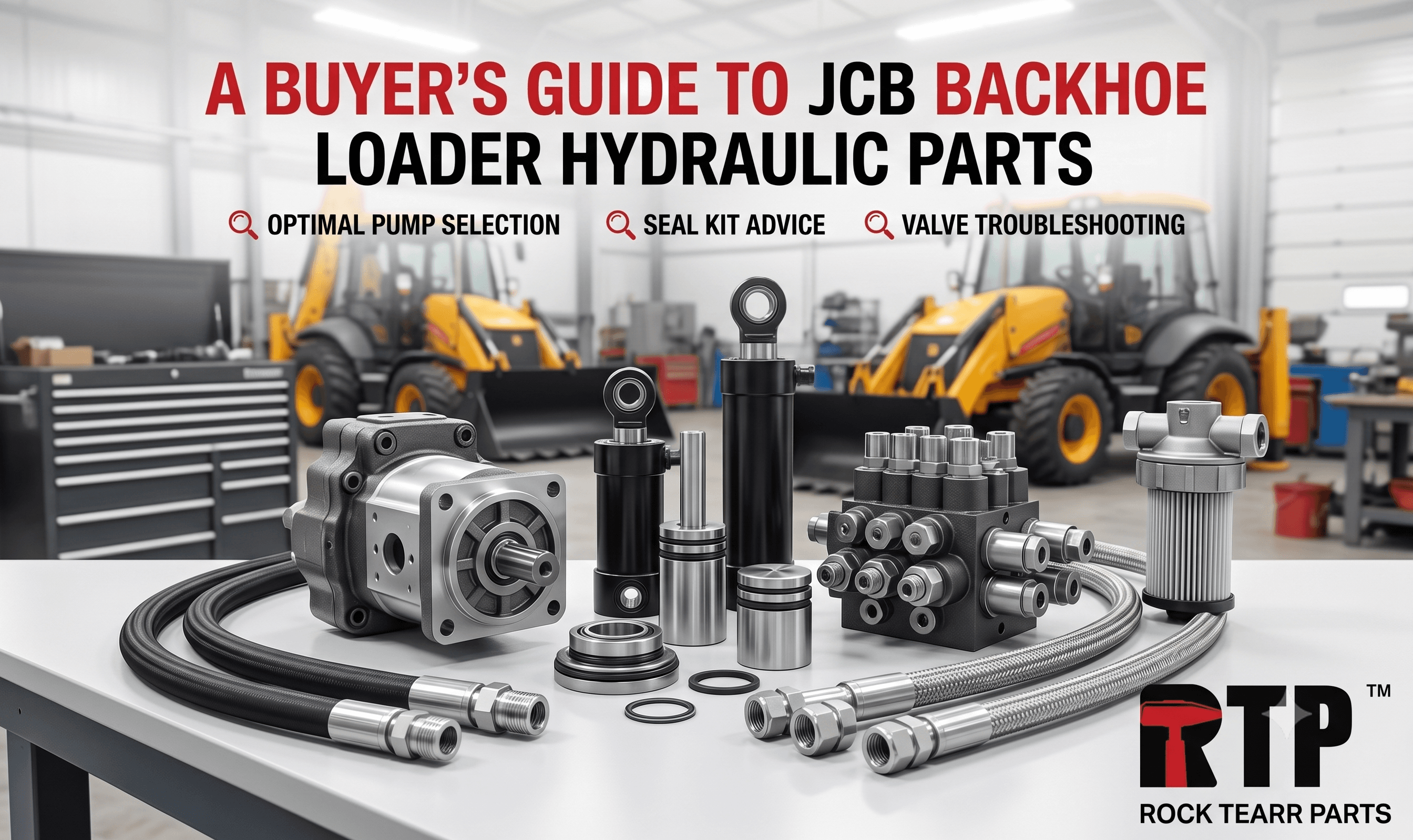
Pumps
Symptoms: whine, grinding, gauge pressure drop, metal in oil.
Possible component: main pump or suction-side restriction (cavitation from low fluid or blocked strainer).
How to check: oil level and colour, suction strainer, recent filter service, whether noise is load-specific. Do not quote a full pump from a cab photo alone.
Identify: machine model + hours, photo of pump area, any casting/OEM marks on the failed unit.
RTP path: pump failure page · losing pressure (3DX) · 3DX hydraulic parts.
Need pump-side lines for a JCB 3DX?
Open the 3DX hydraulics hub or send OEM stamps on RFQ. Fitment is confirmed in writing — we do not invent pump part numbers from a machine colour photo.
Valves and holding circuits
Symptoms: boom settles with a dry gland; drift that is not an obvious rod weep.
Possible component: holding valve or scored spool — often after contaminated oil.
How to check: a mechanic isolates cylinder bypass vs valve leak before you order valves. We do not certify valve settings from an email.
Identify: symptom sentence, whether the gland is wet or dry, oil cleanliness notes, OEM marks if a valve is removed.
RTP path: quote OEM-compatible hydraulic lines after isolation — start from hydraulic cylinder & ram parts and the symptom pages above.
Cylinders and seal kits
Symptoms: external weep at the rod gland, rod scoring, drift under load.
Possible component: seal kit / gland family — not a marketplace “3DX kit” size.
How to check: measure bore ID and rod OD; photograph gland plate and any stamp; name the ram (boom, dipper, bucket, loader, stabiliser).
Identify: bore, rod, cylinder location, OEM/casting stamp, photos.
RTP path: seal kit guide · 3DX cylinder leaking · seals & repair kits.
Have the seal-kit part number?
Send the OEM or casting stamp to RTP. If marks are worn, measure bore/rod and attach photos — model name alone is not fitment.
Hoses, fittings, and contamination events
Symptoms: burst hose, sudden foam, dirty oil after a rupture.
Possible component: hose/fitting plus filters — dirt entered the circuit.
How to check: keep the failed fitting if the stamp is readable; plan filter service and often a tank clean, not hose alone.
Identify: fitting stamp / dash size evidence, machine model, photos of ends.
RTP path: hydraulic parts category · filters. We do not invent hose dash sizes from a cab photo.
Filters, breathers, and oil
Symptoms: bypass indicator, sluggish cold cycle, pump noise from oil starve.
Possible component: return/pressure filter, wrong micron after rebuild, oil grade.
How to check: last filter change, bypass light, oil grade/colour, cold vs hot behaviour.
Identify: filter OEM numbers from the housings, oil grade in use, hour meter.
RTP path: filter clogging symptoms · filters & lubricants · maintenance schedule.
How to check (procurement triage)
- Record hour-meter, oil grade/colour, and whether the fault is load-specific.
- Check oil level, return filter service, and bypass indicators before quoting a pump.
- Isolate cylinder bypass vs valve leak when boom settles with a dry gland.
- For seal kits: measure bore/rod, photograph gland + stamp, name the ram.
- Submit one RFQ with model, serial, OEM stamps, photos, quantity, and destination.
Full ordered workshop sequence: hydraulic troubleshooting guide. Photo path when stamps are unreadable: identify from a photo.
Send a photo or reference number for identification
Stamps and the dataplate beat guesswork. Visual similarity alone is not treated as a match.
Identify from a photo · OEM lookup · Attach evidence on quote
What information to identify before you order
- Machine model and dataplate serial
- Symptom in one sentence (slow boom, leak at gland, bypass light)
- OEM or casting numbers from the failed part
- Bore / rod if quoting a seal kit
- Photos: stamp, wear face, dataplate
- Quantity and destination (India or export)
When to replace vs inspect
Technically defensible triage for procurement — not a workshop certification:
- Inspect first: oil level/colour, filter service interval, bypass indicators, cold-start behaviour, whether drift is wet at the gland or dry (valve vs seal).
- Replace after evidence: scored rod with external weep (seal kit after measurements); metal in oil with pump noise after suction checks (pump family); burst hose ends with readable stamps (hose + filters).
- Do not replace on model name alone: “3DX seal kit” or “3CX pump” marketplace titles are not fitment. Confirm stamps or dimensions on RFQ.
Relevant RTP categories, machines & quote
Categories: hydraulic cylinder & ram · seals & repair kits · filters & lubricants.
Machines: JCB 3DX · JCB 3CX · 3DX hydraulic parts hub.
Lookup: OEM cross-reference · identify from a photo.
Diagnostics: pump · cylinder leak · boom drift · filter clogging.
Request a quote for the lines this map points to
Rock Tearr Parts — independent OEM-compatible supply from Palwali, Faridabad (GSTIN 06ABNFR6695L1Z8). Not a JCB dealer. MOQ, lead time, and fitment on the written quote — RFQ-first, not online checkout.
Request quote · Browse catalogue · Have a part number? Look it up