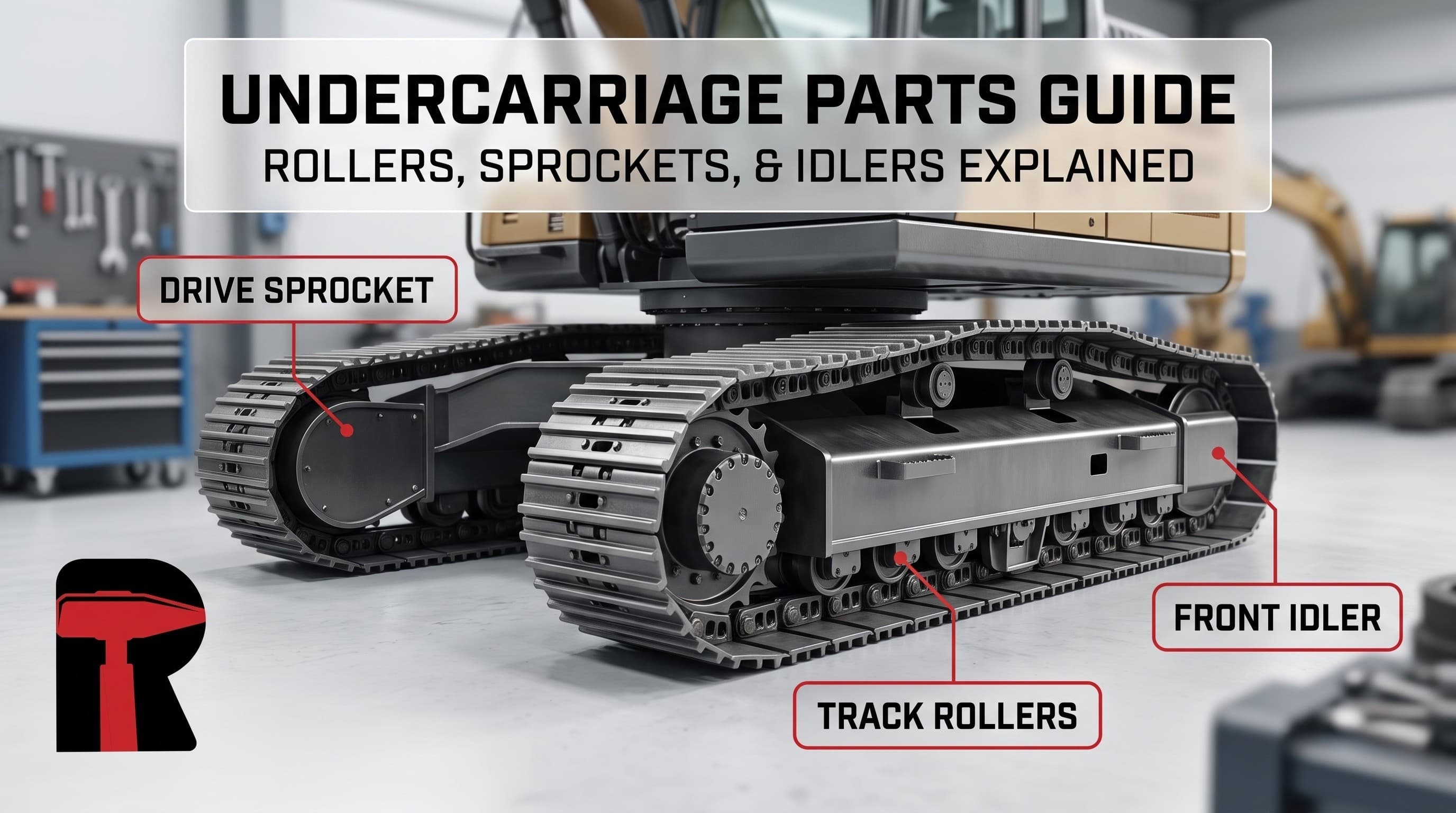
The undercarriage on a tracked JCB machine is a system of interdependent parts, which means understanding how each component works helps explain why they should usually be assessed — and often replaced — together rather than one at a time.
Track chains. The backbone of the system, made up of links and pins that wear and stretch over time. A stretched chain no longer meshes correctly with the sprocket, accelerating wear on both components.
Sprockets. Drive the chain and take direct wear from chain contact. A worn sprocket paired with a new chain (or vice versa) accelerates wear on the new component, which is why manufacturers generally recommend replacing them as a matched set once wear reaches a certain threshold.
Rollers. Support the machine's weight and guide the track. Top rollers (carrier rollers) and bottom rollers (track rollers) both wear over time, and seal failure allowing lubricant loss is often the underlying cause of premature roller failure — not just contact wear.
Idlers. Positioned at the front (and sometimes rear) of the track frame, idlers maintain track tension and alignment. Wear here often shows up as uneven track tracking before it's visually obvious on the idler itself.
Track pads/shoes. On steel-tracked machines, these are the wear surface in direct ground contact. On rubber-tracked machines, watch for cracking, chunking, and steel cord exposure.
Why a full undercarriage assessment matters. Because these components wear as an interconnected system, replacing just one worn part while ignoring wear on the others often means the new part wears prematurely too. A periodic full undercarriage inspection — measuring wear across chains, sprockets, and rollers together — gives a much clearer picture of what actually needs replacing now versus what can wait.
Need the right OEM-compatible line? Cross-check numbers on our OEM database, then request a quote with quantities and machine serial.